
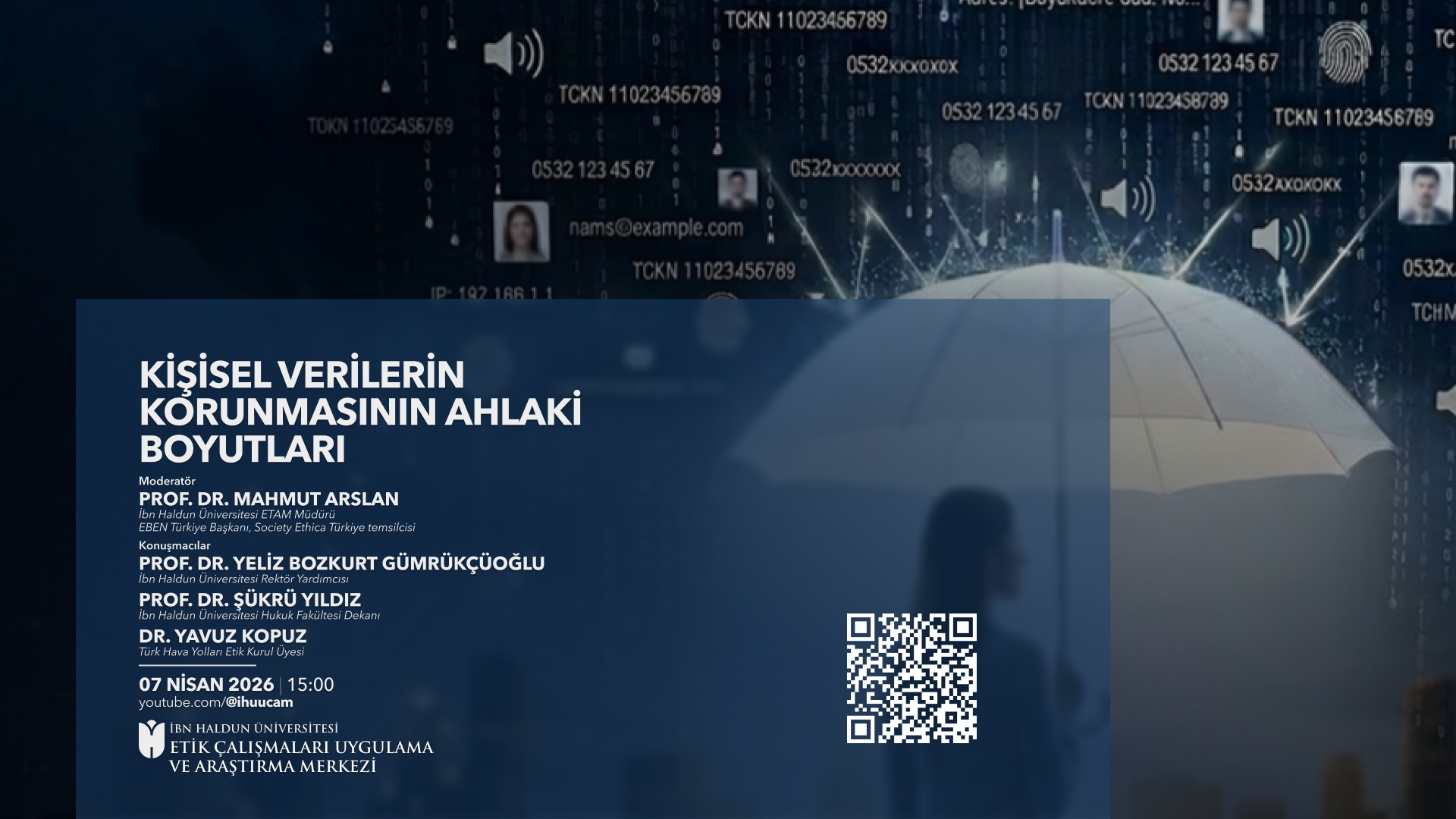
The Boundaries of Privacy and the Ethical Dimensions of Personal Data in the Digital Age Were Discussed
The panel titled “The Ethical Dimensions of Personal Data Protection,” organized by the Center for Applied Research and Studies in Ethics (ETAM) at Ibn Haldun University on April 7, 2026, was streamed live via our university’s UÇAM YouTube channel.
Moderated by Prof. Dr. Mahmut Arslan, the event comprehensively evaluated the boundaries of privacy in the digital world, legal regulations, and ethical responsibilities. At the panel, our university faculty members Prof. Dr. Yeliz Bozkurt Gümrükçüoğlu and Prof. Dr. Şükrü Yıldız, together with Dr. Yavuz Kopuz, Member of the Ethics Committee of Turkish Airlines, took part as panelists, addressing the subject from both academic and practical perspectives.
The Surveillance Society and the Panopticon Metaphor
Prof. Dr. Yeliz Bozkurt Gümrükçüoğlu, who delivered the opening remarks at the panel, defined the protection of personal data not merely as a technical issue but as an area directly related to the individual’s freedom and private life. Comparing today’s digital world to Jeremy Bentham’s Panopticon prison model, Bozkurt highlighted the risk of a “surveillance society” where individuals are constantly under the threat of surveillance. Noting that every tool—from smartphones to social media platforms—collects data, Bozkurt warned that this process could transform into a tool of manipulation capable of interfering with an individual’s autonomy of will.
Legal Framework and Ethical Awareness
Highlighting the importance of the Personal Data Protection Law No. 6698 (KVKK), Bozkurt stated that while the law sets boundaries, it struggles to keep pace with the speed of digitalization, emphasizing that ethical assessments must come into play at this point. He particularly emphasized that artificial intelligence and profiling applications carry the potential to restrict free will by categorizing individuals.
Prof. Dr. Şükrü Yıldız, on the other hand, stated that personal data is not a “property right” but a “right to personality”. Yıldız, who noted that efforts to protect privacy are directly linked to human dignity, argued that in today’s world—where data analysis can even alter voter behavior—ethical awareness stands at a more critical juncture than legal protection.
A Perspective from the Industry: The Turkish Airlines Example
Speaking during the panel’s practical session, Dr. Yavuz Kopuz, a member of Turkish Airlines’ Ethics Committee, explained how data security is ensured in large-scale companies. Highlighting the importance of fostering a corporate culture, Kopuz shared that, in addition to cybersecurity measures, access to data is strictly monitored through log records and permissions are restricted.
The panel also discussed the ethical implications of collecting employees’ health data in the workplace. Dr. Yeliz Bozkurt Gümrükçüoğlu stated that while this is a requirement under occupational health and safety regulations, the information obtained must be limited solely to “fitness for work” decisions; sharing details of an illness with the employer would constitute serious ethical and legal violations.
Conscious Individuals and Transparent Institutions
At the end of the panel, the future risks associated with data such as fingerprints, voice recordings, and digital footprints were discussed. There was a consensus that, in the digital age, legal regulations alone are insufficient for protecting personal data, and that a strong ethical consciousness must develop within society. The central view emerging from the panel was that the protection of personal data is not merely a technical process, but the most critical “moral test” in building the digital future.
The event concluded with an emphasis on the need for individuals to carefully read privacy notices and for institutions to prioritize transparency in their data processing procedures.